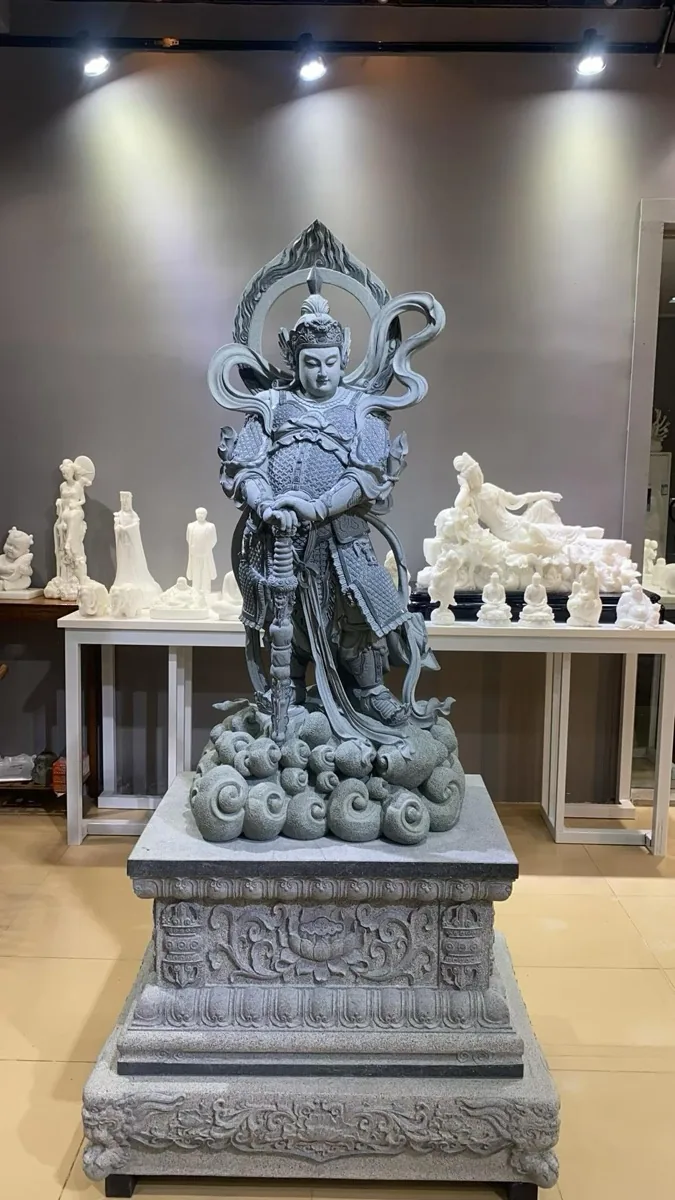
Carving a large figure is only half the job of getting one to a client. The other half is everything that happens between the finished surface and the crate being opened at the destination. Most damage to stone sculpture in transit is not caused by the stone failing. It is caused by packing that assumed the stone would not move.
Nothing over about 2.5 m travels in one piece
Above roughly 2.5 m, a figure is carved in sections — commonly two to seven blocks, depending on the design — and assembled on site. This is decided at the modelling stage, not afterwards, because the joints have to be planned. A good joint sits where it reads least: under a fold of drapery, behind an attribute, or along the axis of a supporting element.
Each block is numbered and supplied with an assembly drawing. Section joints are checked for fit in the workshop, before the pieces are packed. A joint that does not close is a workshop problem, not a site problem.
The crate
Each block goes into a plywood case on foam and timber blocking. The carved faces are wrapped, and the block is braced so that it cannot move inside the case at all. Steel strapping bands the case. The objective is not to cushion the stone but to immobilise it — a carving that cannot shift cannot strike anything.
Plywood matters for a second reason. Solid timber packing can trigger phytosanitary requirements in many destinations, which means fumigation, which means delay and cost. Plywood cases avoid that requirement in the destinations we ship to most.
What we photograph, and why
We photograph every case open and closed, and we photograph the loading as well. This is not marketing — it is the record that decides what happens if there is a claim. If the case arrives with a damaged corner, the photographs show what condition it left in. It also lets the client inspect the piece before signing for delivery rather than after.
The documents
Documents that travel with the goods typically include the commercial invoice, packing list, bill of lading and certificate of origin, plus any destination-specific declaration the shipment requires. Which certificates apply depends on the destination and on the stone.
This is the part of the process where being vague costs the most. A missing certificate at the port can cost more than the entire saving on the carving, because the goods sit and the demurrage runs. So we confirm in writing, at the quoting stage, which documents we will supply for your destination — and if there is one we cannot issue, we say so then rather than at the port.
Shipping terms
Most shipments leave on FOB terms from Xiamen or Fuzhou and can also be arranged on CIF or door-to-door terms through your own forwarder. If you have a forwarder you already work with, we will talk to them directly — that almost always removes a round of confusion about who is responsible for what at the terminal.
Working on a commission like this?
Send us the reference and we will tell you what the stone can and cannot hold — before you commit to anything.