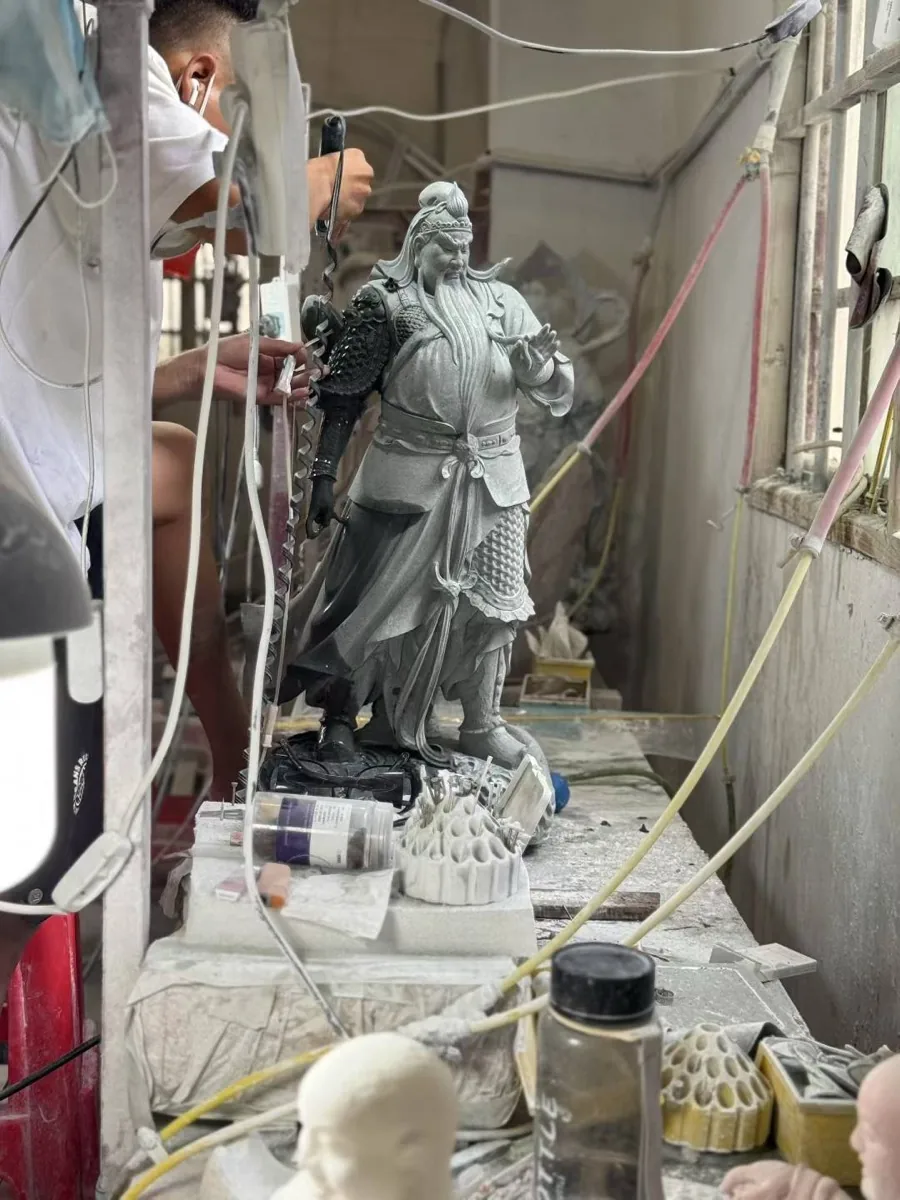
Stone is unforgiving in one specific way: you cannot put material back. Cut past the line on a nose and there is no correction — only a slightly smaller nose. That single fact is why almost every portrait commission in this workshop begins with a clay maquette, and why the maquette stage matters more than any other part of the job.
What the maquette is for
A maquette is a model of the finished piece at a reduced scale — commonly 1:5 for a portrait head, full size for some works. Wet clay can be added to, taken away and reworked indefinitely at almost no cost. A mistake at the maquette stage costs an afternoon. The same mistake in marble costs the block.
We photograph the finished maquette from four angles — front, both three-quarters and profile — and send those images to the client. What you are looking at is the piece, in a material that can still change.
What to look at when you approve it
Clients tend to judge a maquette by the features, because that is what the eye goes to. In practice, the things that make a portrait recognisable are rarely the features:
- The silhouette from the side. Most of what makes a head recognisable is the profile — the forehead, the bridge of the nose, the set of the chin. If the profile is wrong, no amount of good eye work will fix the impression.
- The mass of the head against the shoulders. Proportion reads before detail does. A head that is five per cent too large is noticed instantly, even by people who cannot say why.
- The angle of the ear and the depth of the eye. Both are structural. Both are much harder to change in stone than in clay.
- The expression, separately from the likeness. These are two decisions. A good likeness with the wrong expression reads as the wrong person.
What cannot be changed afterwards
Once the block is committed, the changes still available are surface and detail: refining tooling, sharpening an edge, working a fold of drapery. Changes of proportion are gone. If the head needs to be four centimetres larger, that is a different block.
This is why we will sometimes spend a fortnight on a maquette that the client expected to take three days, and why we will say so before starting the stone rather than after. A commission that closes its maquette stage slowly is usually a commission that finishes without argument.
A practical note on references
Two clear photographs taken in even light at the same distance are worth more than ten taken at a party. What the modelling needs is the geometry of the head: how far the nose projects, where the jaw sits, how much the brow overhangs the eye. Flat, bright, straight-on photographs give us that. Strong side lighting hides it.
If you have only one photograph and it is a three-quarter view, we can still make a good portrait — but we will tell you what we are guessing at.
Send what you have. We will tell you honestly what the reference supports and where we would be inventing, and you can decide whether to accept that before any money changes hands.
Working on a commission like this?
Send us the reference and we will tell you what the stone can and cannot hold — before you commit to anything.