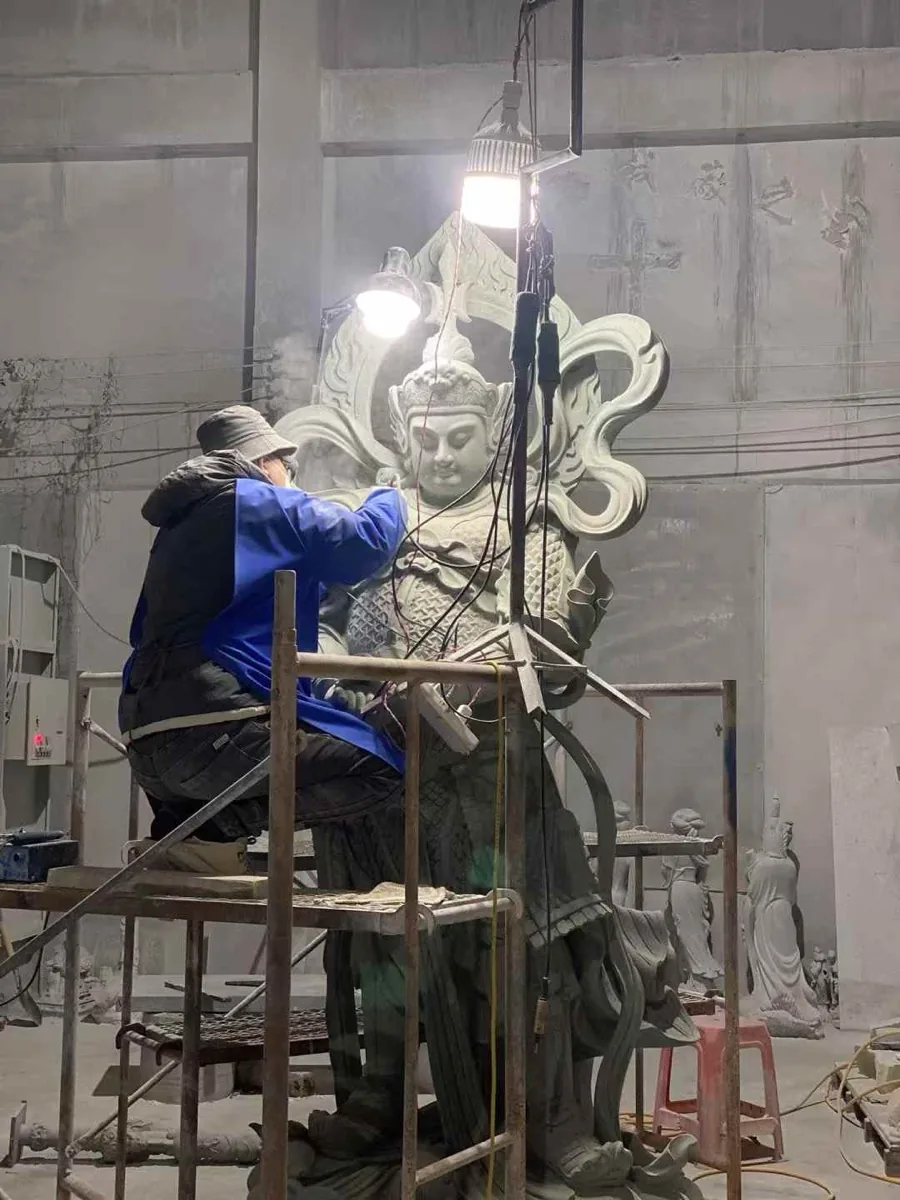
The first question about an outdoor carving is not what it will look like in a photograph. It is what it will look like in ten years, in the weather of the specific place it is going. Those two answers can be very far apart.
Granite
For anything permanently exposed, granite is the safe answer. It is hard enough that fine detail survives handling and tooling, dense enough that water does not sit in the surface, and mineralogically stable enough that colour does not shift with exposure. On coastal sites it is not really a preference — it is the only responsible choice, because wind-driven salt and sand attack softer stones steadily.
The trade-off is weight and working time. Granite is heavier to move and slower to carve, and tool marks take longer to work out of the surface. Both of those affect cost, not durability.
Sandstone and limestone
These give you warmth of colour and a softer, more hand-made surface that granite cannot imitate. They also weather faster. Sandstone can lose surface detail over decades outdoors, and in polluted air it can stain. In colder climates, water that gets into the stone and freezes will lift the surface — this is why a freeze-thaw climate is a hard disqualifier for a porous stone on a detailed piece.
Used knowingly, both are perfectly respectable outdoor materials, particularly for large forms where deep shadow does the work rather than fine detail.
Marble outdoors
White marble outdoors is a decision you should make with your eyes open, not by default. It is the finest of these stones for detail and it looks superb under raking light. It is also softer, more porous, and it discolours under constant exposure — rain will eventually leave grey streaks along the grain, and in industrial air the surface can turn noticeably darker.
Where a client wants marble outdoors anyway, we usually recommend it under partial cover — a niche, a portico, an arcade — where it gets light and air but not driving rain.
The questions we actually ask
- Is the site coastal? Salt and wind-driven sand. If yes, granite.
- Does it freeze in winter? Freeze-thaw cycles are the single most destructive thing that happens to porous stone outdoors.
- What is the air like? Industrial and urban atmospheres stain lighter stones faster.
- How much fine detail is in the design? Very fine detail and a soft stone is a mismatch; the detail is gone in a decade.
- Is the piece fixed or does it need to move? A piece that will be relocated needs a stone that survives handling twice.
Answer those five and the stone usually chooses itself. Where it does not, we will recommend one and explain what you are giving up by choosing the other — which is a more useful answer than a preference.
Working on a commission like this?
Send us the reference and we will tell you what the stone can and cannot hold — before you commit to anything.